





Beyond depressed mood: a brain-network perspective on somatic symptoms in depression
- Date:
- 2026-09-15
- Title:
- Beyond depressed mood: a brain-network perspective on somatic symptoms in depression
- Content:
Depression involves not only low mood and loss of interest but also sleep disturbances, gastrointestinal discomfort, pain, appetite and weight changes, and fatigue. These somatic manifestations are closely associated with disease burden, illness course, and treatment response, making them an important dimension for understanding the clinical heterogeneity of depression. Against this background, a review co-authored by Assistant Professor Xiang Wang of the Institute of Social Psychology, School of Humanities and Social Sciences, Xi'an Jiaotong University, in collaboration with the Affiliated Mental Health Centre & Hangzhou Seventh People's Hospital, Zhejiang University School of Medicine, was published online in Behavioural Brain Research on 3 September 2026.
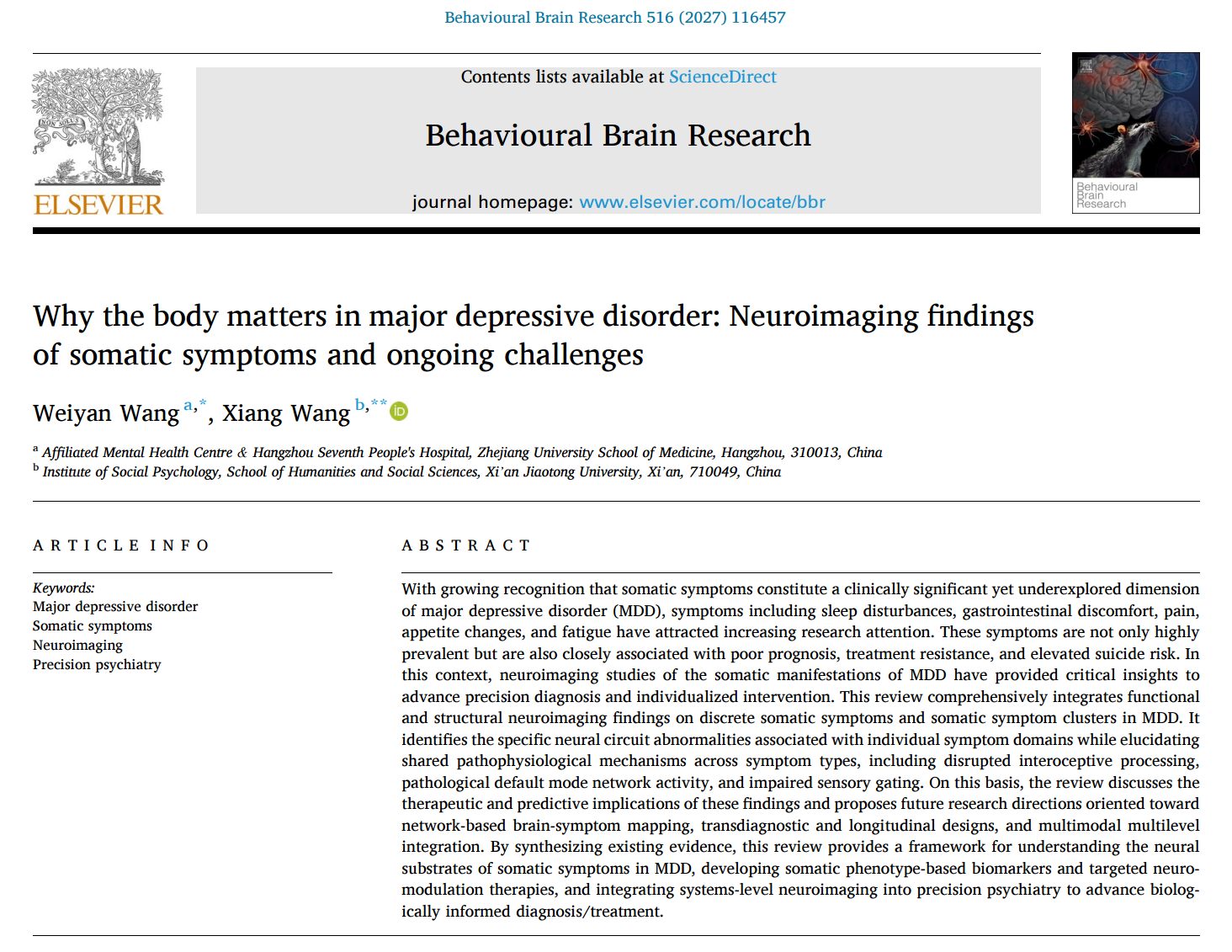
The review examines neuroimaging evidence on somatic symptoms in major depressive disorder and the challenges facing this field. It synthesizes structural and functional imaging findings across individual somatic symptom domains and overall somatic symptom burden, discussing potentially symptom-specific and shared neural mechanisms. Existing evidence suggests that different somatic symptoms may involve partially overlapping brain-network alterations related to the perception and processing of internal bodily signals, self-referential processing, and the filtering and regulation of sensory information. Important differences also exist within symptom domains. Increased and decreased appetite, for example, have been associated with differing patterns of reward-related and interoceptive activity. These findings highlight the importance of examining specific symptom presentations rather than overall symptom severity alone.
The review also emphasizes that the available evidence is predominantly correlational. It remains unclear whether brain-network alterations are causes or consequences of somatic symptoms, or whether both are influenced by other factors. Evidence is uneven across symptom domains, with particularly limited neuroimaging research directly examining fatigue in depression. Clearer symptom measurement, longitudinal and transdiagnostic studies, and multimodal, multilevel data integration are needed to further investigate these potential mechanisms.
The review highlights somatic symptoms as an important dimension of depression heterogeneity and calls for research to move beyond isolated symptoms or individual brain regions toward the relationships between symptom presentations and brain-network organization. This framework may inform future research on stratified assessment based on somatic phenotypes, biomarkers, and personalized interventions, although the clinical utility of these approaches requires further validation.
The article, entitled "Why the body matters in major depressive disorder: Neuroimaging findings of somatic symptoms and ongoing challenges", was published in Behavioural Brain Research. The first author is Dr. Weiyan Wang, a postdoctoral researcher at the Affiliated Mental Health Centre & Hangzhou Seventh People's Hospital, Zhejiang University School of Medicine. Assistant Professor Xiang Wang of the School of Humanities and Social Sciences, Xi'an Jiaotong University, is a co-corresponding author.
Article link: https://doi.org/10.1016/j.bbr.2026.116457