



论文被Chemical Engineering Journal接收
- 发布时间:
- 2025-05-18
- 文章标题:
- 论文被Chemical Engineering Journal接收
- 内容:
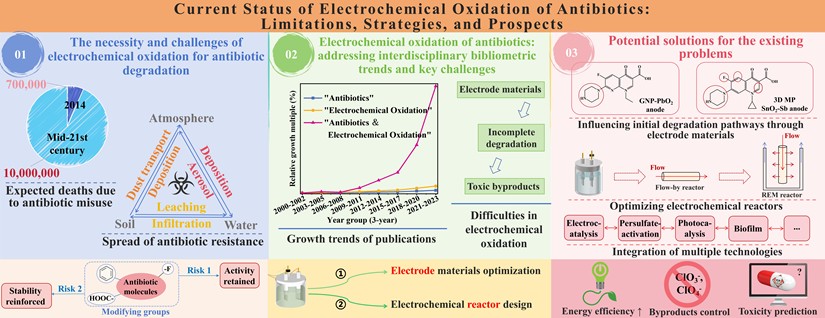
今日获知,王新宇同学的论文Degradation of Antibiotics by Electrochemical Oxidation: Current Issues, Environmental Risks, and Future Strategies被Chemical Engineering Journal接收。论文获得国家自然科学基金资助。摘要如下:The escalating discharge of antibiotics and the global crisis of bacterial resistance have driven an urgent demand for advanced water treatment technologies. Electrochemical oxidation (EO) has emerged as a promising solution due to its high efficiency, operational stability, and environmental compatibility in eliminating antibiotic pollution. This review employs bibliometric analysis to explore application trends of EO technology and assess its associated environmental risks: particularly the overlooked dissemination of antibiotic resistance genes (ARGs). Notably, current research primarily focuses on the degradation or transformation rates of target antibiotics, while often neglecting the incomplete degradation products or toxic byproducts. The review also systematically summarizes the structure-dependent environmental behavior of antibiotics, emphasizing how specific molecular features, particularly pharmacophores and certain functional groups, govern their environmental persistence and mobility. While this concept is further extended to the EO degradation of antibiotics, elucidating the dominant mechanisms of EO processes and how they preferentially target specific functional groups within antibiotic molecules, while also highlighting the potential risk that pharmacophores may retain their structural integrity and biological activity after treatment. Finally, the review proposes strategies to advance EO technology by optimizing electrode materials, improving electrochemical reactor design, and integrating synergistic degradation technologies, aiming to enhance antibiotic mineralization efficiency, minimize the formation of toxic byproducts, and broaden the applicability of EO technology to diverse water matrices. The findings provide actionable insights: to enhance the safety, scalability, and sustainability of EO systems for antibiotic wastewater treatment.
- 上一条:史雪瑶、胡文钰、李珍同学通过硕士学位论文答辩
- 下一条:获批陕西省杰出青年科学基金