




论文被Separation and Purification Technology接收
- 发布时间:
- 2026-04-01
- 文章标题:
- 论文被Separation and Purification Technology接收
- 内容:
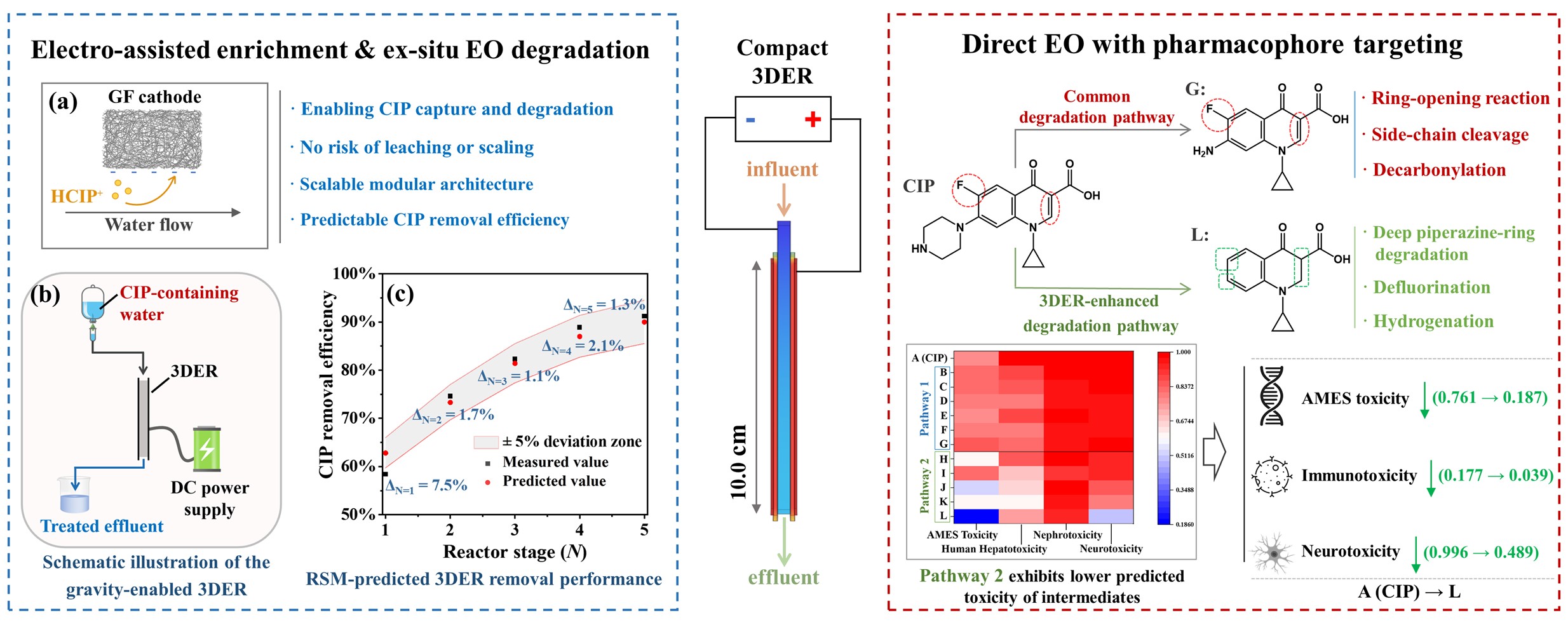
今日,王新宇同学的论文Dual-regime ciprofloxacin treatment via electro-assisted enrichment and direct electrochemical degradation in a gravity-enabled 3D electrochemical reactor被Separation and Purification Technology接收。论文得到国家自然科学基金、陕西省杰出青年科学基金和山东省重点研发计划的资助。论文摘要如下:
Electrochemical oxidation (EO) is a promising technology for antibiotic abatement; however, its practical application is often limited by incomplete degradation, the formation of toxic byproducts, and pronounced efficiency losses in low-conductivity waters. In this study, a compact and modular three-dimensional electrochemical reactor (3DER) was developed to enable efficient treatment of ciprofloxacin (CIP) under low-conductivity conditions (~100 μS cm⁻¹). At low current density, the 3DER functions as an electro-assisted enrichment unit, achieving rapid removal of aqueous CIP via adsorption-dominated processes. Using response-surface methodology (RSM), optimal single-pass operating conditions (pH ~ 5.0, flow rate ~ 1100 mL h⁻¹, five serially connected units) were identified, resulting in a CIP removal efficiency of 91.2%, in close agreement with the model prediction (~90%). Consistently high removal efficiencies (>90.0%) were obtained under both gravity-driven operation and pump-assisted operation, demonstrating the operational flexibility of the 3DER across simplified and controlled hydraulic conditions. Surface characterizations revealed that electro-assisted adsorption is the governing step for CIP enrichment, involving the coexistence of physisorbed and chemisorbed species on the graphite felt cathode. When operated at elevated current densities, the 3DER could also function as a standalone electrochemical degradation reactor. Under these conditions, hydrogenation and C–F bond cleavage (defluorination) pathways were preferentially promoted, leading to deeper structural transformation of CIP through disruption of its key pharmacophoric motifs and an associated reduction in predicted toxicological risk. The 3DER provides a compact electrochemical option for antibiotic removal under low-resource operating conditions.
- 上一条:赴中国科学技术大学进行学术交流
- 下一条:获一项发明专利授权