





论文被Separation and Purification Technology接收
- 发布时间:
- 2026-04-27
- 文章标题:
- 论文被Separation and Purification Technology接收
- 内容:
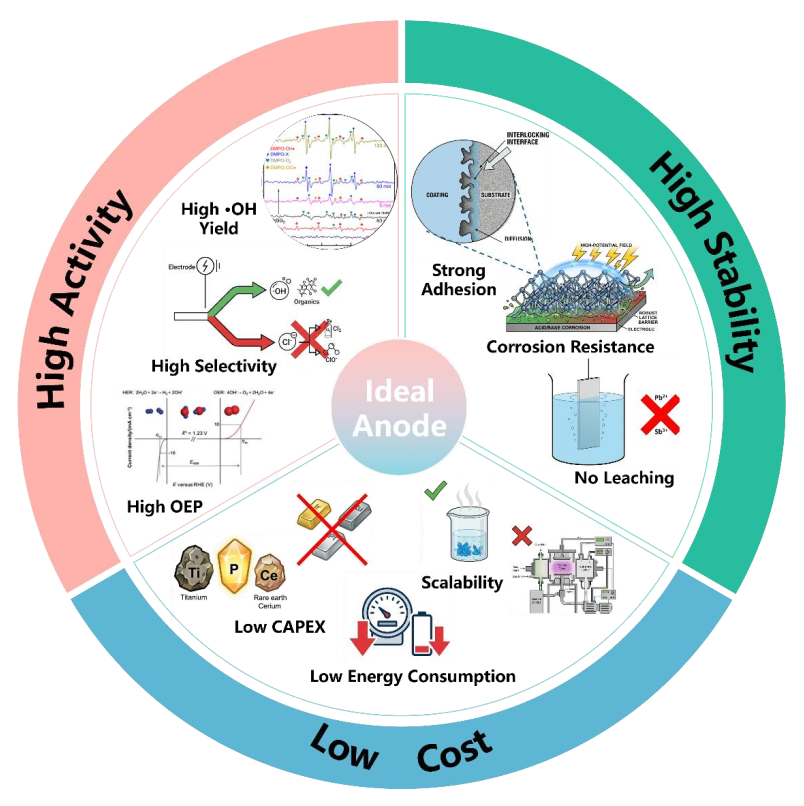
今日获知,刘旭同学的论文Advanced Anode Design for the Electrochemical Degradation of Refractory Organic Pollutants——From Materials Engineering to Mechanistic Insights被Separation and Purification Technology接收。论文得到国家自然科学基金、陕西省杰出青年科学基金、山东省重点研发计划和西安交通大学基本科研业务费的资助。论文摘要如下:
Electrocatalytic advanced oxidation processes (EAOPs) are premier technologies for the deep mineralization of recalcitrant organic pollutants (ROPs) due to their clean operation and efficient in situ generation of reactive radicals. However, the development of core anode materials remains constrained by the "activity-stability-cost" ternary paradox. "Active" anodes, such as RuO2, offer stability but suffer from severe oxygen evolution side reactions that limit mineralization efficiency; conversely, "non-active" anodes like boron-doped diamond (BDD) achieve superior mineralization but face prohibitive costs and scalability challenges. This paper establishes a key performance indicator (KPI) system for ideal anodes and systematically reviews advanced design strategies to overcome these bottlenecks across three dimensions. At the atomic scale, electronic structures are regulated via elemental doping and defect engineering to optimize intrinsic activity. At the nanoscale, heterojunctions and functional interlayers are constructed to resolve the trade-off between conductivity and stability. At the macroscale, three-dimensional porous electrodes and flow-through reactors are developed to enhance mass transfer efficiency. Furthermore, we explore the critical roles of in situ spectroscopic characterization, density functional theory (DFT), and machine learning (ML) in elucidating reaction mechanisms and facilitating material reverse design. Finally, the review addresses challenges regarding matrix effects, standardize lifetime assessment, and engineering scale-up, aiming to propel anode development from traditional trial-and-error approaches toward data-driven rational design.