



论文被Water Research接收
- 发布时间:
- 2026-06-14
- 文章标题:
- 论文被Water Research接收
- 内容:
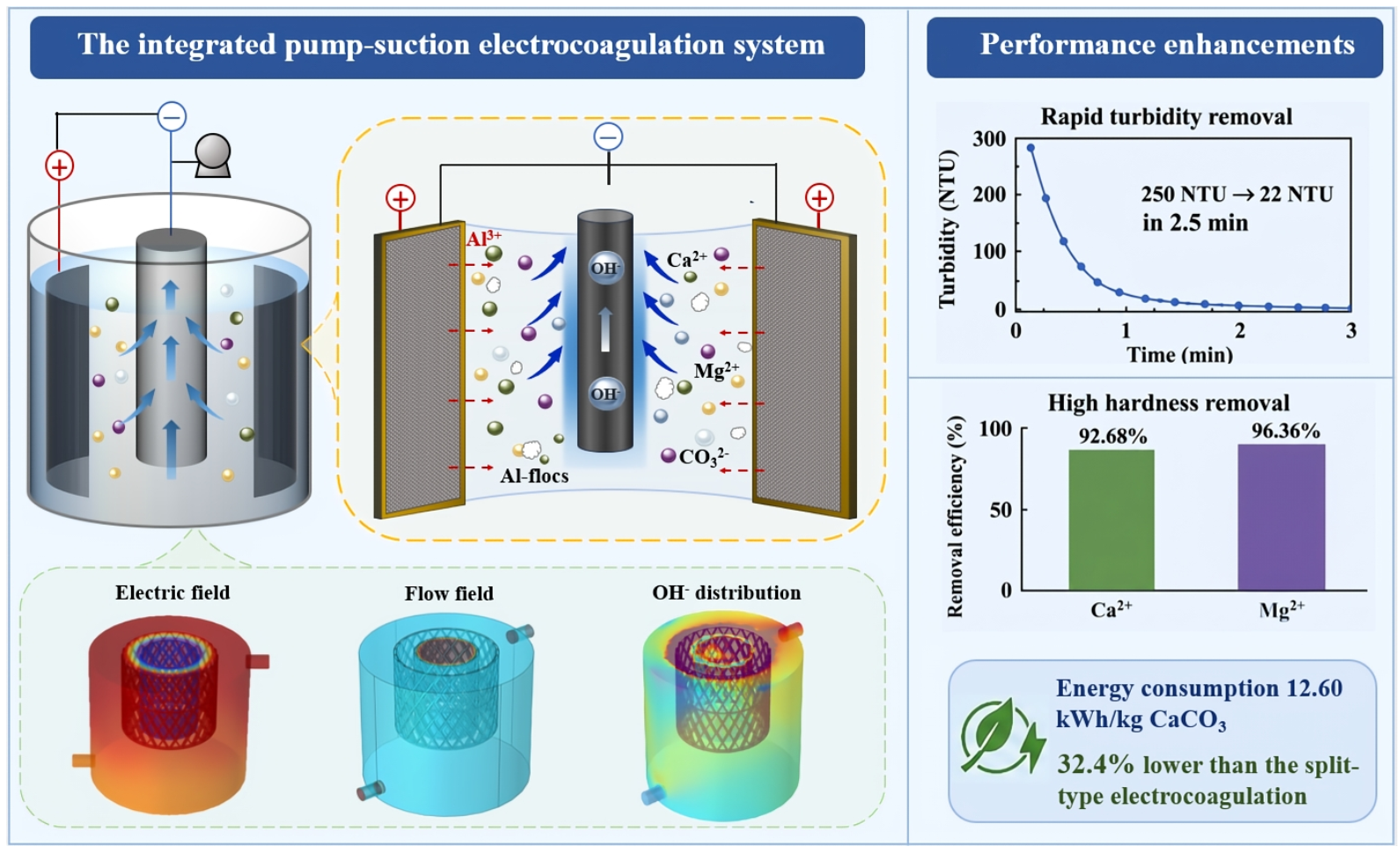
今日获知,刘蕴贤和常跃馨同学的论文An Integrated Pump-Suction Electrocoagulation System for Accelerated Hardness Removal: Process Intensification and Crystallization Mechanisms被Water Research接收。论文得到国家自然科学基金、陕西省杰出青年科学基金和山东省重点研发计划资助。论文摘要如下:
Conventional electrochemical softening processes are often constrained by the spatial decoupling of precipitation and solid-liquid separation, resulting in slow crystallization kinetics, high chemical demand, and limited process integration. To overcome these limitations, three progressively intensified systems, namely pump-suction chemical flocculation (PCF), split-type electrocoagulation (SPE), and integrated pump-suction electrocoagulation (IPE), were developed based on a membrane-free pump-suction architecture. Among them, the IPE system spatially integrates cathodic alkalinity generation and the in-situ release of active Al species from a composite anode into a single reactor. Multiphysics simulations revealed that the coupling of a converging flow field and a centripetal electric potential gradient promoted the directional transport of scaling ions and OH- toward the cathode region, thereby establishing a confined alkaline microenvironment with intensified reaction coupling. Compared with the single pump-suction system, the apparent removal rate constants of Mg hardness and turbidity increased by approximately 5-fold and 12-fold, respectively. Under optimal conditions, turbidity rapidly decreased from 250 NTU to 22 NTU within 2.5 min, while Ca and Mg hardness removal efficiencies finally reached 92.68% and 96.36%, respectively. Meanwhile, the specific energy consumption was reduced by 32.4% compared with the SPE system. Mechanistic analyses further demonstrated that the synergistic interaction between cathode-induced precipitation and anodically released Al species facilitated nucleation, accelerated ordered crystal growth, and promoted the formation of dense Ca-Mg carbonate aggregates with enhanced settling behavior. Overall, this work demonstrates that rational reconstruction of the electrochemical reaction space can effectively shift the rate-limiting step of hard-water softening from nucleation to mass transfer and particle aggregation, providing a compact and low-chemical strategy for energy-efficient water softening.
- 上一条:课题组赴西安建筑科技大学交流
- 下一条:李昕圆、李世基、常跃馨通过硕士学位论文答辩