



论文被Journal of Water Process Engineering接收
- 发布时间:
- 2026-08-13
- 文章标题:
- 论文被Journal of Water Process Engineering接收
- 内容:
今日获知,俞可迪和王新宇同学的论文Electrochemical Advanced Oxidation Processes for Water Treatment: Reactive-Species Regulation, Materials Design, Process Coupling, and Engineering Translation被Journal of Water Process Engineering接收。论文得到国家自然科学基金、陕西省杰出青年科学基金的资助。摘要如下:
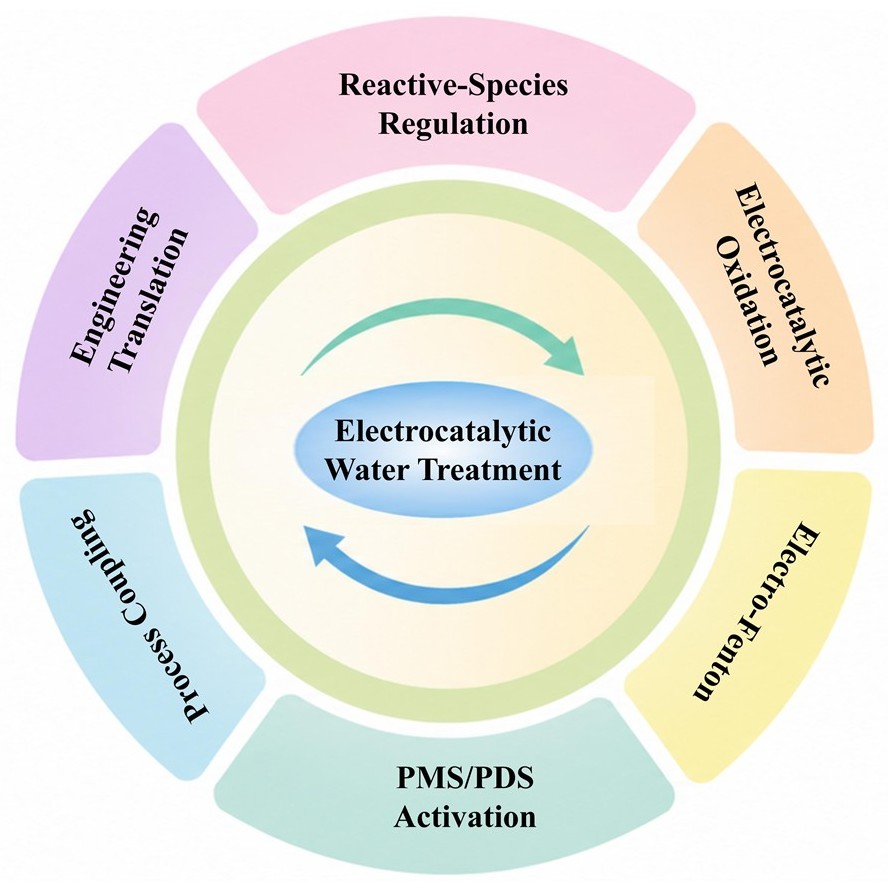
Electrochemical advanced oxidation processes (EAOPs) have emerged as promising technologies for the advanced treatment of refractory organic pollutants, with electrocatalytic materials playing a central role in determining reactive species generation, reaction pathways, and process efficiency. This review focuses on the application of electrocatalytic materials in water treatment and systematically examines reactive species regulation, electrode processes, materials design, process coupling, and engineering implementation. First, the generation pathways, reaction characteristics, regulation strategies, and potential by-product risks of key reactive species are reviewed. Second, representative electrochemical processes, including anodic oxidation, Electro-Fenton processes, and electrochemical activation of persulfates, are compared in terms of their reaction mechanisms, material requirements, and applicable operating boundaries. The structure–activity relationships of electrode materials are then summarized from the perspectives of defect engineering, interface engineering, and morphological and pore-structure regulation, with particular emphasis on the intrinsic relationships among material structure, electronic properties, interfacial reactions, and macroscopic performance. Furthermore, multiprocess coupling strategies, including photoelectrocatalysis, coupled EF–PMS/PDS systems, anodic oxidation–cathodic reduction, bioelectrochemical processes, and resource-recovery-oriented conversion, are discussed. Future development of electrocatalytic water treatment should move beyond the removal of individual pollutants toward the directional regulation of reactive species, adaptation to complex water matrices, low-energy operation, and synergistic resource recovery. Finally, engineering challenges are summarized from the perspectives of techno-economic analysis, life-cycle assessment, reactor scale-up, long-term electrode stability, and intelligent process operation. A standardized research framework oriented toward real wastewater matrices, continuous-flow operation, and full life-cycle assessment is proposed. Overall, electrocatalytic water treatment technologies exhibit considerable potential for transitioning from laboratory-scale performance validation to practical engineering applications. Nevertheless, their large-scale implementation will depend on coordinated advances in low-cost and highly stable electrodes, scalable reactor configurations, multiprocess synergistic mechanisms, and systematic economic and environmental assessment.