



张洋
 我的新闻
我的新闻发布时间:2025-04-27
文章标题:【学术成果】一篇通讯作者文章在国际学术期刊 Chemical Engineering Journal 上发表
内容:
本文揭示了盐浓度和蒸发速度如何决定晶体的形态!
Cited as: Zhang, B., Niu, Y., Wang, H., Guo, P., & Zhang, Y. (2025). Experimental and numerical study on crystallization paths and crystal morphology of water-NaCl droplets evaporation. Chemical Engineering Journal, 163162.
https://doi.org/10.1016/j.cej.2025.163162
Abstract: The interaction between crystallization and internal concentration profile leads to diverse crystallization paths and crystal morphologies during the brine droplet evaporation. It can not rely solely on experimental observation or numerical simulation to explain the differences between crystallization paths and crystal morphologies when brine droplets evaporate under different conditions. Here, a numerical model was developed based on the Population Balance Model to provide the detailed internal concentration profile, serving as a complementary microcosmic perspective to droplet evaporation experiments. A new five-stage partition for the evolution of the dimensionless temperature was proposed to describe the evaporation and crystallization of the brine droplets. The crystallization start time is summarized as a function of the initial droplet concentration and the theoretical evaporation time of pure water droplets at identical conditions. The nucleation mechanism was investigated, explaining the self-regulation mechanism of critical supersaturation Sc = 1.8, at which crystallization begins, by classical nucleation theory. And explanations for the formation of single-crystal and multi-crystal morphologies were provided. Four distinct crystallization paths and their associated morphological patterns were summarized. The different paths were distinguished by the Peclet number and the droplet initial concentration. The relevant results have implications for the understanding and design of the brine spray evaporation process.
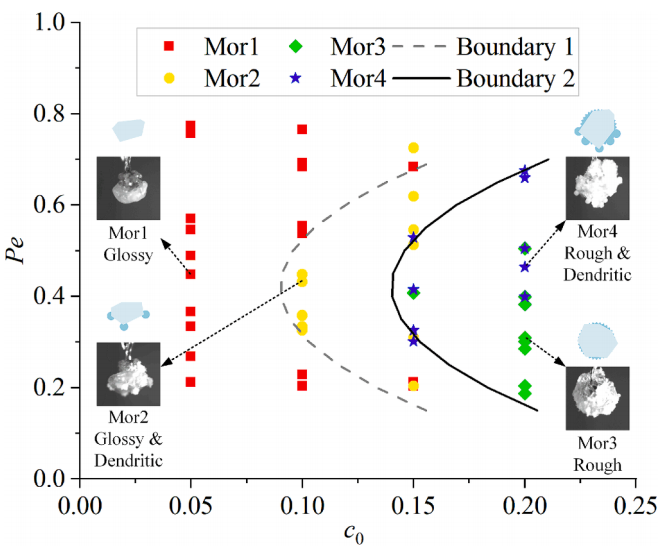
Fig. Droplet morphology distributed with the initial droplet concentration and Pe number.
