


张洋
 我的新闻
我的新闻发布时间:2026-09-03
文章标题:【学术成果】一篇通讯作者文章在国际学术期刊 Energy Reports 上发表
内容:
我们基于ReSCAL模型,系统研究了光伏阵列倾角、密度和风向对固沙与发电性能的协同影响,提出了垂直与倾斜组件混合布局的优化策略,并通过经济评估模型验证了高密度阵列下垂直安装的综合价值优势。
Cited as: Menglei Li, Hang Cai, Kaiyuan Guan, Yao Xue, Yanmei Song, Shuhui Wang, Penghua Guo, Yang Zhang, Zizhen Lin(2026). A ReSCAL-based numerical study on synergistic optimization of photovoltaic arrays for sand control and power generation. Energy Reports, 109639
https://doi.org/10.1016/j.egyr.2026.109639
Abstract: In arid desert environments, photovoltaic (PV) arrays not only serve as clean energy suppliers, but also act as physical barriers to mitigate wind-blown sand movement. Based on the Real-Space Cellular Automaton Laboratory (ReSCAL), this study explores the coupled effects of PV array parameters (tilt angle β, array density rf, and wind direction γ) on the performances of sand control and power generation of PV arrays. Wind conditions are categorized into Interval A1 (γ ϵ [0, 45°]∪[135°, 225°] ∪[315°, 360°]) and Interval A2 (the remaining γ ranges). The results show that β significantly influences sand fixation and blocking capacities, and this influence is amplified by increasing rf. The sand fixation efficiency peaks at rf = 0.9. A robust exponential correlation is established between sand accumulation and velocity reduction capacities: ξvm = 0.958·e0.4963ξnm (R2 = 0.97) for Interval A1. Leveraging the sand control advantage of vertical PV modules and the power generation superiority of traditional tilted modules, this study proposes a hybrid array configuration. Sequential hybridization, which prioritizes vertical modules in the southern sector, yields optimal performance provided the array scale is constrained (e.g., limited to Na ≤ 2 array rings) to preserve sand control benefits. A comprehensive evaluation model is further established by monetizing both sand control and power output, yielding an annualized Expected Value of Solar (EVS) of 100 ¥·m−2·a−1 and an Expected Value of Blocking (EVB) of 0.4 ¥·m−2·a−1. The main contribution is a synergistic optimization framework that balances sand control and power generation. Although vertical installation sacrifices some power generation, it compensates through substantially enhanced sand control, making it the optimal choice for maximizing comprehensive value in high-density arrays (rf > 0.8). This approach provides a practical design guideline for desert PV plants.
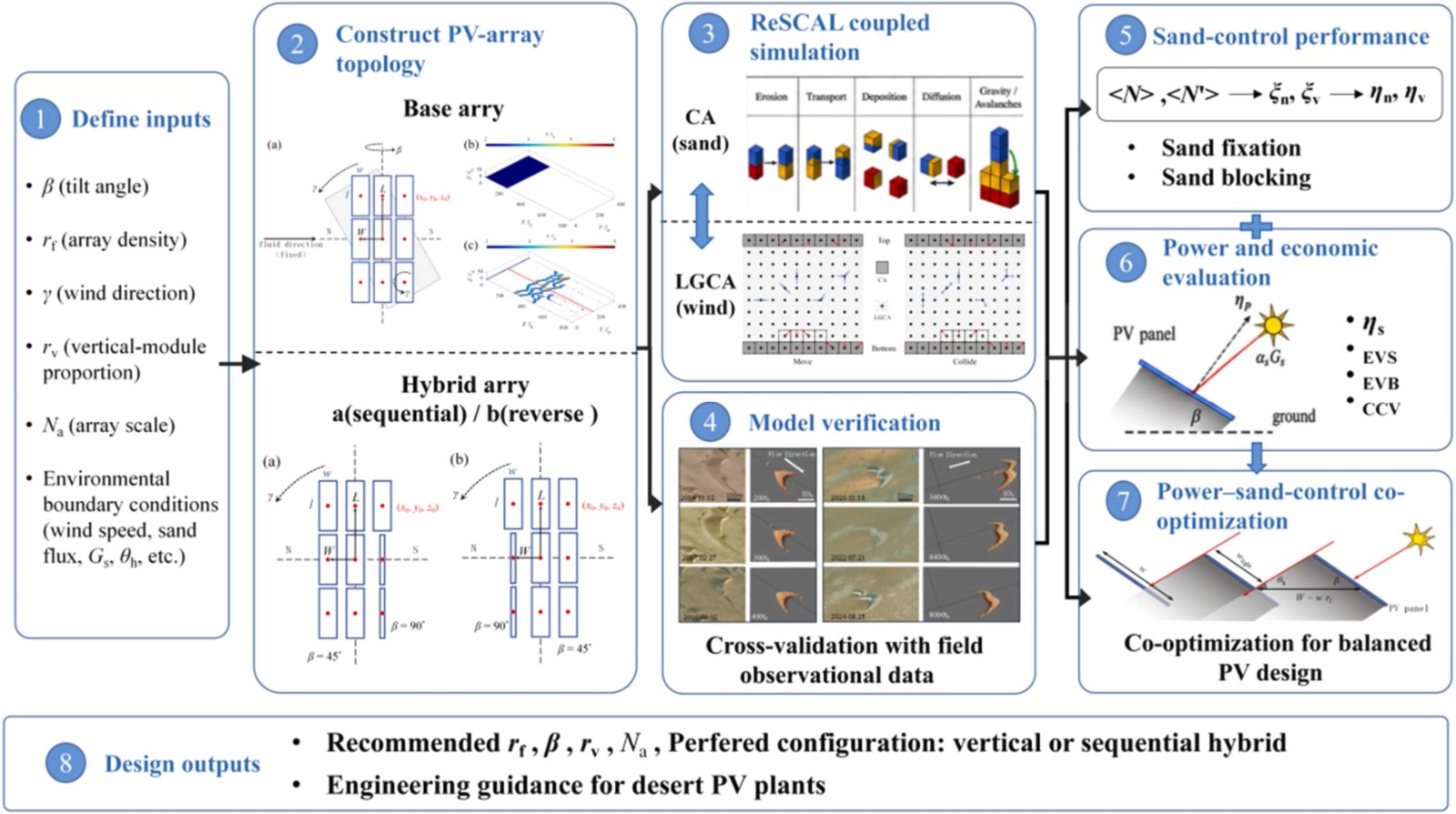
FIGURE. Integrated architecture and operational workflow of the proposed ReSCAL-based PV array optimization system. The workflow includes input definition, PV-array topology construction, ReSCAL coupled simulation, model verification, sand-control performance quantification, power/economic evaluation, power–sand-control co-optimization, and final design recommendation. The arrows indicate the operational sequence and data flow among different modules.
