



祝令瑜
 代表性著作
代表性著作
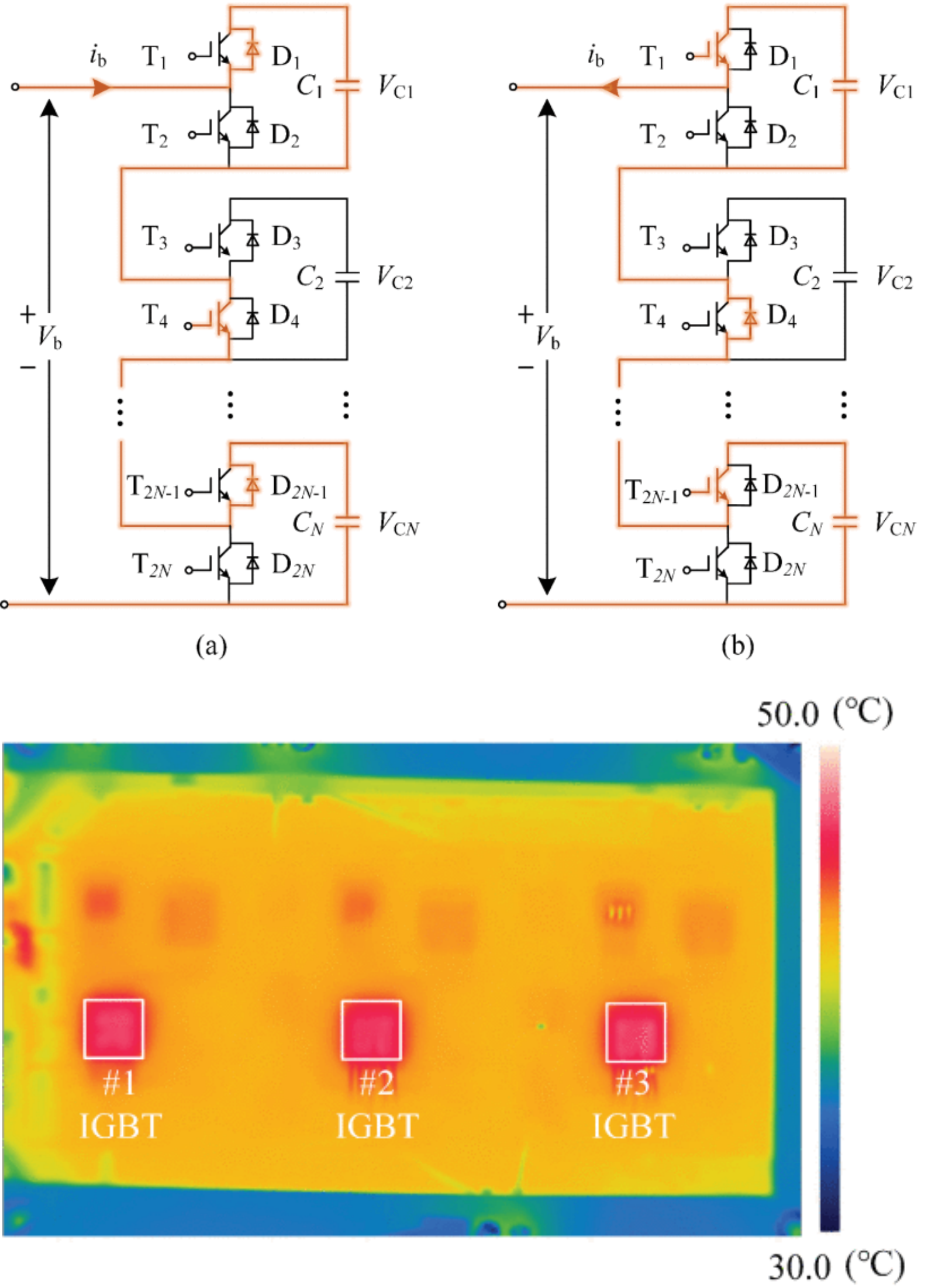
A Novel Sensor-Reduction Condition Monitoring Approach for MMC Submodule IGBTs Based on Statistics of Inferred On-State Voltage
Condition monitoring (CM) of modular multilevel converters (MMCs) submodule insulated gate bipolar transistors (IGBTs) is of significance to ensure reliable operation. The ON-state voltage of IGBT is a promising indicator to perform CM while its application in MMC is tricky due to high blocking voltage and numerous submodules. In this article, a novel sensor-reduction approach is presented to infer the ON-state voltages of MMC submodule IGBTs. Such an estimation method of the ON-state voltages is based ON Kirchhoff’s voltage law (KVL) applied to an MMC arm. This method focuses on a statistical analysis of capacitor voltages and arm voltages. The switching-state combinations are specifically selected for the purpose. A case study is conducted on a single-phase seven-level MMC test bench to verify the proposed ON-state voltage estimation method, which only shows an error of less than 3%. Furthermore, continuous ON-state voltage estimations are made with this MMC test bench under steady-state operations and carry out statistical analysis of the inferred ON-state voltage at various deterioration levels. Finally, a confusion matrix is proposed, whose maximum accuracy reaches 92.4% for the early-deterioration condition.
Analytical Double-2D Frequency-Dependent Leakage Inductance Model for Litz-Wired High-Frequency Transformer
Accurate and fast calculation of frequency-dependent leakage inductance is critical for the optimization of the high-frequency transformer with Litz wire winding. The analytical method is widely used due to its high computation speed. However, its computation accuracy is limited due to the following factors. First, one-dimensional (1D) or two-dimensional (2D) magnetic field model has unsatisfying accuracy for the transformer with a rotationally asymmetric structure. Second, the skin and proximity effect factors based on the multilayer foil winding are inaccurate for the Litz wire winding in the calculation of frequency-dependent magnetic energy. This article proposes a double-2D frequency-dependent leakage inductance model for the transformer with Litz wire winding. It uses the image method to calculate the 2D leakage magnetic field inside and outside the core window, respectively, which considers the rotationally asymmetric structure in leakage inductance calculation. The round conductor model is proposed for the frequency-dependent magnetic energy calculation. The single strand in a Litz wire is taken as the basic modeling object of the round conductor model, which is more detailed than the multilayer foil winding model for the Litz wire winding. The comparison between the experiment, FEM, state-of-the-art models, and the proposed model is conducted for eight transformers with E-core, U-core, round, or rectangular Litz wire winding. The proposed model shows satisfying computation accuracy in the whole frequency band. And the computational speed of the proposed model is 100 times that of the FEM.
A Large-Scale Identification Approach for Thermal Parameters of Multichips IGBT Modules Based on LLSO-SQP Algorithm
This article proposes a large-scale optimization approach for identifying thermal parameters of multichips insulated-gate bipolar transistor (IGBT) modules. State-space equation, in which the coefficient matrix comprises the thermal resistance and capacitance, is provided to represent the compact 3-D thermal network model. Then, the level-based learning swarm optimization (LLSO) algorithm is first utilized to identify large-scale thermal parameters. Additionally, to solve the inefficient convergence problem, the optimization results obtained from the LLSO are provided as the initial value of the sequential quadratic programming (SQP) algorithm to find the global optimal solution. Hence, the proposed LLSO-SQP algorithm can identify the large-scale thermal parameters efficiently and accurately. The training dataset for the algorithm is derived from the transient temperature response of a finite element model (FEM) of the IGBT module under power step excitation. Since only one-time simulation is in-demand, this approach needs less computational effort than others. The identified thermal network model is utilized to estimate junction temperature profiles taking a two-level inverter as a case study. In comparison to that of the experiment and FEM, the results validate the feasibility and accuracy of the junction temperature estimation method based on the compact 3-D thermal network model.
