





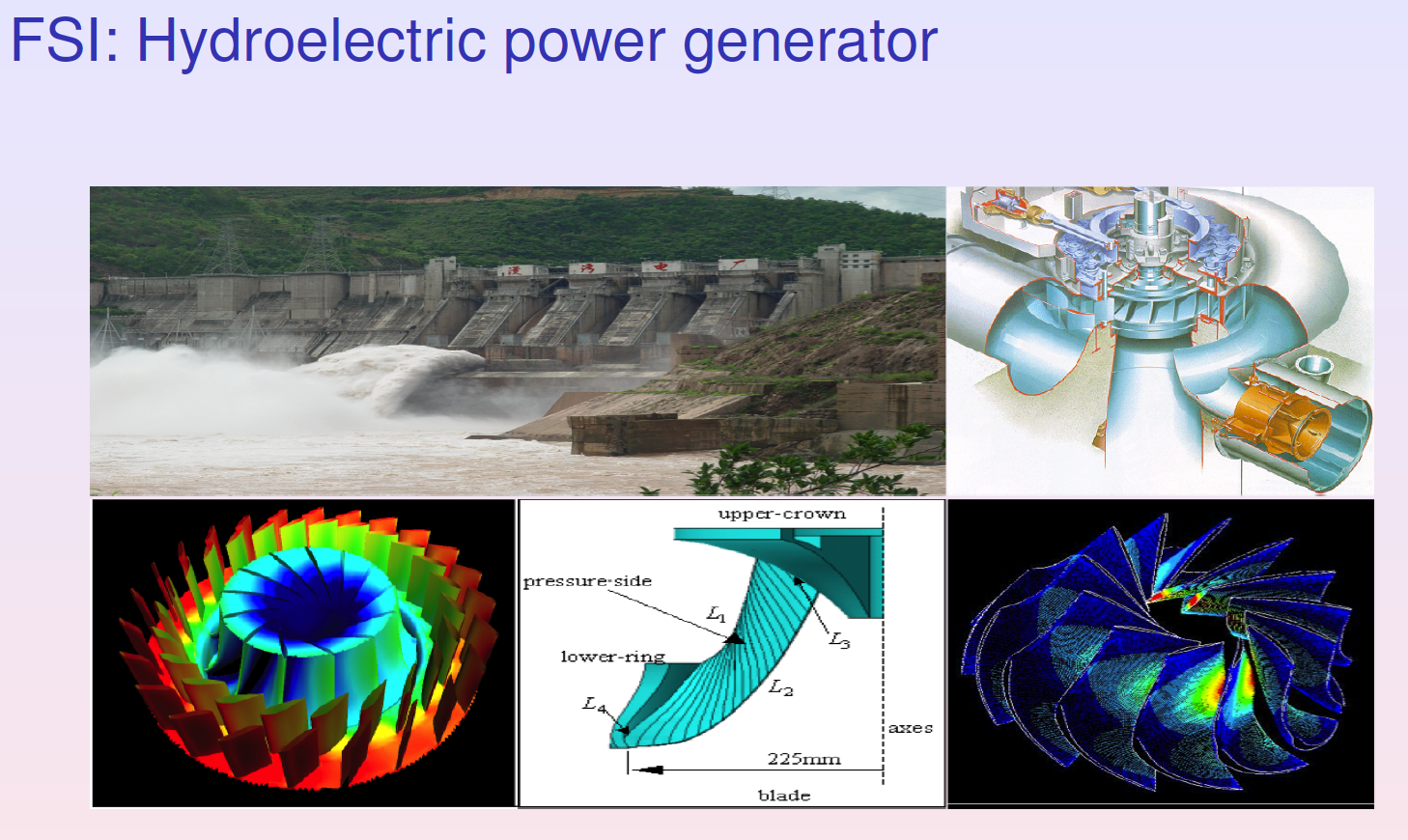
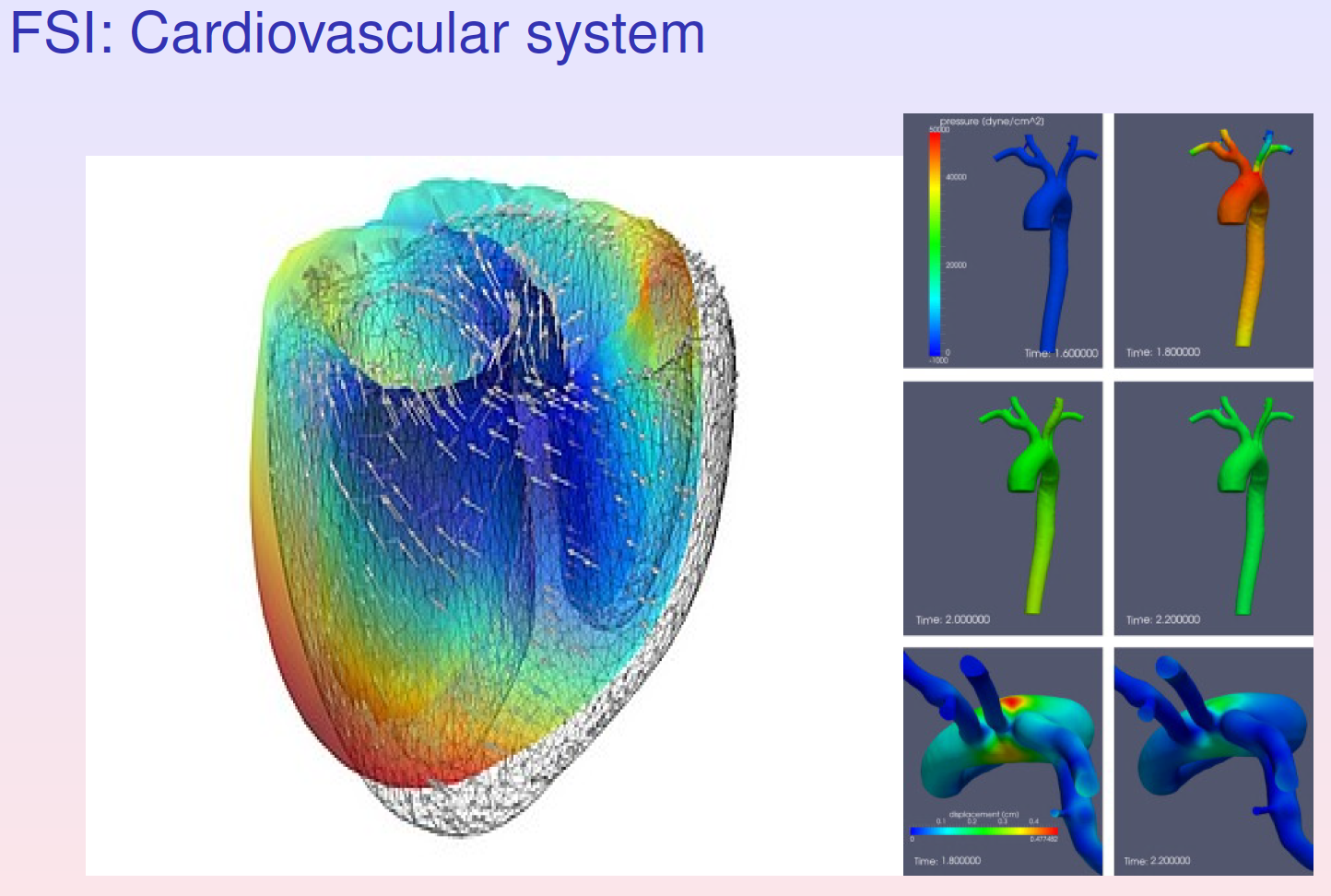
Many problems in physics and engineering contain a certain level of coupling between different physical systems, for example, fluid-structure Interaction (FSI) problems, and multi-phase flows, etc. FSI is a coupled partial differential equation system, which describes how a moving solid object interacts with the fluid surrounding it. This problem is very complex and challenging due to its highly nonlinear and coupled nature. Moreover, the position and the shape of the interface between fluid and structure is time dependent and is one of the unknowns, which greatly increases the nonlinearity of the problems both theoretically and computationally. FSI has a wide range of applications in many areas including hydro turbines and aircraft designing, artificial heart simulations and etc. Mathematically, such a problem contains an interface where the coupling takes place. Therefore, the numerical discretization of the interface problem is very important in the applied sciences and mathematics. The standard finite element cannot achieve the optimal convergence order due to lack of resolution for the interface. The interface-fitted mesh can be used to overcome this difficulty, but if the problem is time-dependent, the domain needs to be re-meshed at each time step, which introduces interpolation error between two meshes. The extended finite element method extends the classical finite element method by enriching the solution space locally around the interface with discontinuous functions, and it is realized through the partition of unity concept. This approach provides accurate approximation for the problems with jumps, singularities, and other locally nonsmooth features within elements. The hardest part of error analysis for XFEM is the trace and inverse inequalities on the curved sub-elements divided by interface from a triangle element, especially they do not hold true for the shape irregular sub-element. Therefore, the standard analysis for finite element methods cannot be applied to the analysis of stability for the high order XFEM. Worked with Dr. Shuo Zhang (Chinese Academy of Sciences), we applied quadratic XFEM with Nitsche scheme to solve elliptic interface problems. We have proved one key inequality for any shape of interface under certain assumptions, and then we are able to show that this method achieves the optimal convergence order ([7]). Furthermore, recently, I have been working with Prof. Xu and Dr. Yuanming Xiao (Nanjing University) on arbitrary order XFEM with Discontinuous Galerkin schemes on interface problem. Optimal error estimates in the piecewise H1-norm and in the L2-norm are rigorously proved for both schemes. In particular, we have devised a new parameter-friendly DG-XFEM method, which means that no “sufficiently large” parameters are needed to ensure the optimal convergence of the scheme ([8]). This parameter-friendly DG-XFEM method can be applied to solve interface couplied multiphysics problems, like the simulations of hydroelectric power generator, cardiovascular system and hydraulic fracturing.

[7] Fei Wang and Shuo Zhang, Optimal Quadratic Nitsche Extended Finite Element Method for Solving Interface Problem, Journal of Computational Mathematics, 36 (2018), 693-717.
[8] Fei Wang, Yuanming Xiao and Jinchao Xu, High-Order Extended Finite Element Methods for Solving Interface Problems, submitted.