Research Focus
Current position: Home > Research Focus
Topological Quantum Phases of Matter
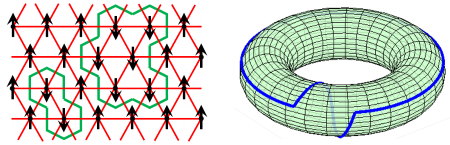
Topological quantum matter represents a novel class of quantum states in many-body systems whose properties are determined by patterns of quantum entanglement. Unlike conventional phases of matter, they cannot be characterized by local physical observables but instead require a global topological description. The discovery of the fractional quantum Hall effect in the 1980s provided the first experimental evidence for such exotic quantum states. In 2016, the Nobel Prize in Physics was awarded to three physicists for their theoretical discoveries of topological phases of matter and topological phase transitions.
In recent years, the rapid development of quantum simulation platforms—such as superconducting qubits, trapped ions, and Rydberg atoms—has enabled the experimental realization and detection of various topological quantum states. The study of topological quantum matter not only advances the fundamental understanding of condensed matter physics, but also provides a promising foundation for quantum technologies, including quantum information storage, quantum error correction, and topological quantum computation.