
Scientific Research
Current position: Home > Scientific Research
Research Field
Quantum Circuits
Quantum Entanglement Dynamics
Measurement-Induced Phase Transitions
Quantum Error Correction
Quantum Many-Body Scars
Topological Quantum Phases of Matter
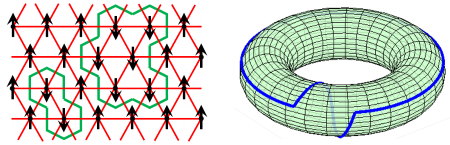
Topological quantum matter represents a novel class of quantum states in many-body systems whose properties are determined by patterns of quantum entanglement. Unlike conventional phases of matter, they cannot be characterized by local physical observables but instead require a global topological description. The discovery of the fractional quantum Hall effect in the 1980s provided the first experimental evidence for such exotic quantum states. In 2016, the Nobel Prize in Physics was awarded to three physicists for their theoretical discoveries of topological phases of matter and topological phase transitions.
In recent years, the rapid development of quantum simulation platforms—such as superconducting qubits, trapped ions, and Rydberg atoms—has enabled the experimental realization and detection of various topological quantum states. The study of topological quantum matter not only advances the fundamental understanding of condensed matter physics, but also provides a promising foundation for quantum technologies, including quantum information storage, quantum error correction, and topological quantum computation.
Tensor Network States
Tensor network methods provide powerful theoretical and numerical tools for studying quantum many-body systems. They offer an efficient representation of quantum states with complex entanglement structures and significantly reduce the exponential computational complexity typically associated with many-body problems. The density matrix renormalization group (DMRG) is one of the most successful and widely used tensor network algorithms.
In recent years, tensor network methods have found broad applications in condensed matter physics, quantum information science, quantum chemistry, and machine learning. My research employs various tensor network algorithms to investigate complex quantum many-body systems, with a particular focus on the numerical simulation and physical characterization of topological quantum states and their phase transitions.

Generalized Symmetry and Topological Order Parameters
Symmetry is one of the most fundamental concepts in modern physics. In condensed matter and statistical physics, the classical theoretical framework for understanding phases and phase transitions is Landau’s theory of spontaneous symmetry breaking, which characterizes different phases through local order parameters. However, certain quantum phases—such as topological phases—cannot be described within this traditional framework.
To understand these phenomena, it is necessary to introduce a more general concept of symmetry, known as generalized symmetry, and to develop new theoretical frameworks.
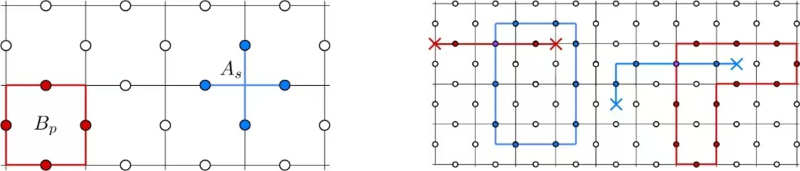
Order parameters play a central role in detecting spontaneous symmetry breaking within Landau theory. Similarly, in topological quantum matter, one aims to construct topological order parameters based on generalized symmetries to characterize topological phases and their phase transitions, thereby exploring possible extensions of the traditional Landau paradigm.
Other Research Interests

Publications
More- Wen-Tao Xu, Qi Zhang and Guang-Ming Zhang.Tensor Network Approach to Phase Transitions of a Non-Abelian Topological Phase , Physical Review Letters , 2020 , 124 : 130603
- Wen-Tao Xu and Norbert Schuch.Characterization of topological phase transitions from a non-Abelian topological state and its Galois conjugate through condensation and confinement order parameters , Physical Review B , 2021 , 104 : 155119
- Wen-Tao Xu and Rui-Zhen Huang.Finite Correlation Length Scaling of Disorder Parameter at Quantum Criticality , Physical Review Letters , 2025 , 134 : 146503
- Wen-Tao Xu, Tibor Rakovszky, Michael Knap and Frank Pollmann.Entanglement Properties of Gauge Theories from Higher-Form Symmetries , Physical Review X , 2025 , 15 : 011001
- Wen-Tao Xu, Frank Pollmann and Michael Knap.Critical behavior of Fredenhagen-Marcu string order parameters at topological phase transitions with emergent higher-form symmetries , npj Quantum Information , 2025 , 11 (74) : 1-10
Patents
MorePublished Books
- To be updated...